Sack, a member of Notre Dame's 1966 national championship football team, went on to earn his Ph.D. at Pennsylvania State University. He has been widely-quoted by national media in stories about college athletics, and is the author of numerous scholarly publications including Counterfeit Amateurs: An Athlete's Journey Through the Sixties to the Age of Academic Capitalism. He is a founding member of The Drake Group. We sat down with Allen Sack and learned what he is doing inside and outside of the classroom.
Because I’ve been here for three decades I’ve been able to teach a wide variety of courses in several different programs. At another college I might have been forced into a narrow specialty area. I have taught courses ranging from the nature of science to sport management and organizational theory. I teach both undergraduate and graduate students and I love it. I teach both freshmen students and working students. I am constantly challenged at UNH. I love our diverse student body. I love the fact that I’ve seen so many students who I thought would never be able to find their way from one classroom to another, but who 30 years later are CEOs of major corporations. Teaching and seeing students grow is a very rewarding experience. Every day is a constant learning experience. I can’t imagine doing anything else. I have also watched UNH grow, and turn into the place I’ve always dreamed it would be; that is a great feeling. There have been positive changes to the campus and its programs. Because the overall environment has been transformed, students feel better about themselves. This helps with retention and improves the overall quality of students.
I worry that we may be, in some instances, using technology at the risk of abandoning traditional methods that might be more appropriate in some disciplines. I am also worried that students may not read as much as they should and that we may be producing a generation of students who are print illiterate. I also worry that students may be developing a shorter attention span as our media have reduced complex ideas to sound bites. The explosion in technology can’t be ignored, and has tremendous potential for broadening students’ horizons. Students now have access to immense amounts of information. The challenge is to separate the facts from the spin. Exposure to reading great literature and analyzing concepts in depth will continue to help students make this distinction. Our goals as professors will continue to be to create well educated citizens with marketable skills and the ability to think critically. Technologies and methods of instruction will change. But Yet, this basic goal will remain unchanged if we want our universities to be the best in the world.
Experiential Learning is part of every class in the College of Business.
Sports marketing via “new media” is now getting a great deal of attention internationally. Research on the role of sport in higher education has actually spawned a number of new journals and research institutes. Financial issues in sport industries are receiving more and more attention as programs are emerging in colleges of business.
I love sport sociology, history, and the management of sport.
Accounting and finance which is crucial to every human being.
I expect students to take notes. Writing things down allows students to better learn. Students should engage in active reading. Student should be actively involved in their education. They should be prepared, curious, keep questions going in their heads even if they don’t ask them, argue in the best sense of the word for educational purposes and be engaged in their educational experiences.
A survey of NFL ballplayers to assess the dimensions of the “underground economy” in college sport and attitudes toward employee benefits for college athletes in revenue producing college sport programs.
Be actively involved in your education. Be aware of your course requirements and how the registration process works; don’t have to constantly rely on your advisor to guide you through the process. Incoming students should take a close look at the courses in their major before their first visit with their advisor. Become involved in campus life and develop interpersonal skills by working in teams. The most successful students I have known have been “self starters.” Students should learn independence, but not hesitate to seek out their advisors to talk about their future career plans or how things are going in the classroom. Being independent does not mean you can’t seek out help when you need it, or that you can’t learn from others. Get to know your faculty and advisor.
New media in terms of advertising. The concept of “global” sports allows corporate sponsors to sell world wide. Cable allows us to have so many different contests at any time. Technology has transformed sports management. Fans now have the world of sports literally at their finger tips on their cell phone or Blackberry.
We are more career orientated, yet grounded in liberal arts education. With our experiential learning curriculum we provide students with the skill set that they will need for the work force. At UNH we emphasize practicum and community service for our students. We have professional enrichment programs. The kinds of things that we offer in one semester from mock interviews from corporations, to career development, to guest speakers who are corporate executives to workshops on how to dress for success, how to network and how to smooze. We stand apart by teaching interpersonal skills that are needed when students enter the workforce. Combined with the quest for knowledge in the classroom, our experiential focus offers the best of two worlds.
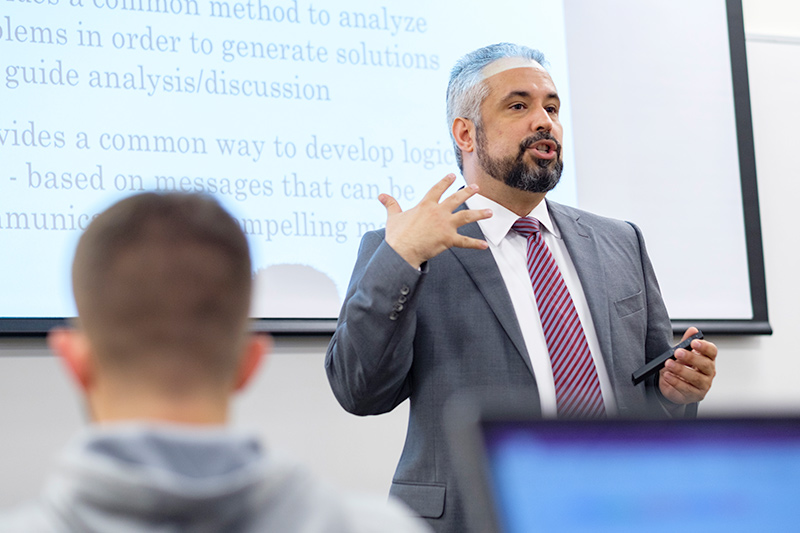
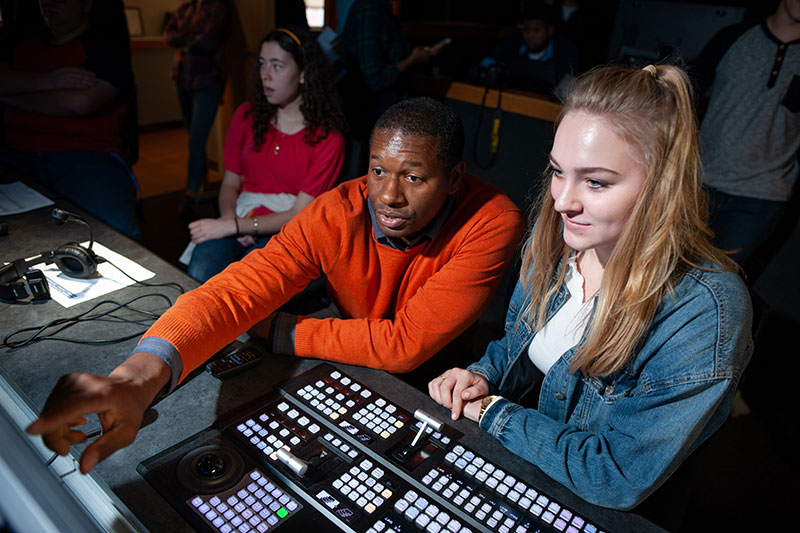
I have always emphasized activities outside of the classroom to immerse students in real life experience. I have taken students to the South Bronx as part of a Social Problems class. Now that I teach sport management, I invite guest speakers into the classroom. We visit sport industries and tour coliseums. We get out into the community. In the classroom I try to get students to think critically and to engage them in discussion. Even in the age of computers and power point presentations, this method is effective and important. I use different methods for different classes. Every method is a situational thing. Sometimes technology is beneficial and sometimes it can be a distraction. My goal is to get students to start talking and interacting which is needed for education. I still use the Socratic Method in the classroom. One crucial outside experience for students is internships. Our students have done internships at Madison Square Garden, with the Boston Red Sox, Special Olympics, area Health and Fitness Centers, Sports Marketing Firms, and Jewish Community Centers. UNH’s location between Boston and New York is saturated with sport businesses. Our students are all over the place.
The technology applications I use most often are DVDs/videos, YouTube for film clips on past events such as the 1936 Olympics and current management practices at major corporations. I also download financial data on sport franchises and other segments of the sports industry. I use power point presentations when appropriate and the document screen on a regular basis. The Internet has allowed me to bring current information and illustrations into my class discussions in a way that was not possible only a few years ago. Just about anything can be located online, and projected on a screen. Blackboard has also helped me in the classroom to explain class assignments and to post articles, course outlines, exams, etc.
The most important attribute is caring that every student in the class is actually engaged in the learning process. If students are not participating in class—perhaps because they are shy—they should nonetheless be thinking about questions being raised. One can walk by a classroom and tell by looking in students eyes whether they are engaged or off in another world. That is how I evaluate instructors. Some instructors seem oblivious to the fact that no one is listening to them or engaging in a dialogue of some sort. Others, regardless of teaching style, will do everything in their power to engage their students. This is important. Teaching styles may vary from one instructor and discipline to another but the ability to inspire learning is crucial to good teaching.
I admire all of the people who care about UNH and its students. There are too many to list.
The major strengths of the University of New Haven’s Management of Sports Industries program (undergrad enrollment 140) are as follows: Faculty with national reputations in sport management, Placement of sport management in the school of business, SMPRC accreditation, Strong internship program, Strong network of industry contacts and national advisory board, Business School with a strong experiential learning focus, Smart classroom technology, Rec and fitness center, financial center, Professional enrichment center, Small classes, personal attention, Location in Boston-New York City corridor, Outstanding Professional Enrichment Program, and a Strong Emphasis on Experiential Learning
Sports law, Facility management, Sports media & communication, Financial aspects of sports, Sports event management, Health and fitness industries, and Collegiate sport.
I attended the University of Notre Dame. Major Catholic University ranked in the top 20 major national universities in America. UNH is a regional university without doctoral program. Our emphasis on experiential learning at the undergraduate level is a strong point. We are smaller and offer students more individualized advising and smaller classrooms.
The greatest challenge that I face as an instructor is getting young students to have a spark of excitement about ideas, and intellectual curiosity to explore major issues of our times. Student’s writing skills are deteriorating. That is a challenge. Grade inflation is a challenge. The use of student evaluations used to evaluate the instructor is a problem when it is the only criteria for the evaluation of the instructor. I am also being challenged to use new technologies in my classes. This is a good thing. Handling the enormous amount of email is also negatively affecting productivity.
I try to avoid trends, and to adopt only those changes that have proven successful through a period of time.