University of New Haven graduate candidate Muhammad Ali ’27 MPH reflects on attending the 2026 SOPHE Advocacy Summit in Washington, D.C., where he developed advocacy skills, met public health professionals, and learned how research can inform policy and improve community health.
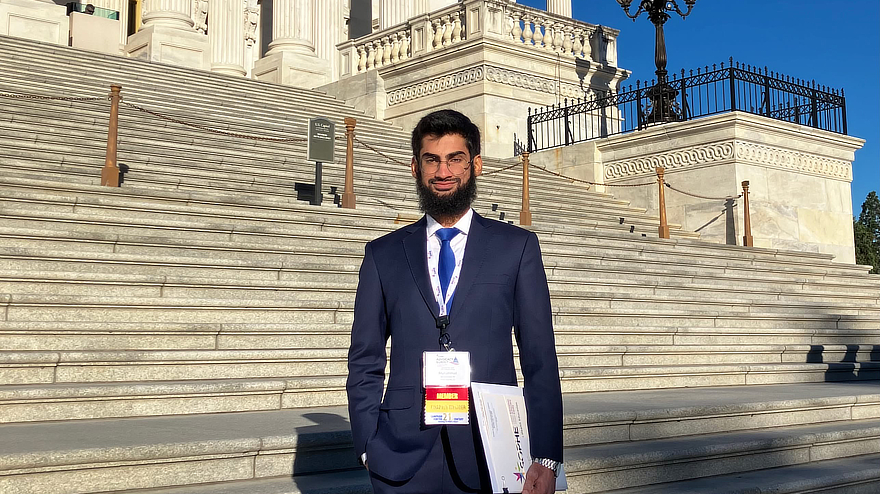
As a Master of Public Health (MPH) student at the University of New Haven and a WeEmbody (WE) Lab Fellow, I have spent much of my academic journey learning about the importance of research, evidence-based interventions, and public health practice. However, I have always wondered what public health advocacy looked like beyond the classroom. How does research influence policy? What does it mean to advocate for public health funding? And how can students like me contribute to these conversations?
I had the opportunity to explore these questions firsthand when I attended the 2026 Society for Public Health Education (SOPHE) Advocacy Summit in Washington, D.C., as a student ambassador representing the Connecticut Society for Public Health Education (CT SOPHE).
Through my involvement with the WeEmbody Lab under the mentorship of Alvin Tran, Sc.D., MPH, associate professor and chair of the Department of Population Health and Leadership, I have been encouraged to pursue opportunities that connect academic learning with public health practice and community engagement. With Dr. Tran's nomination and support, I received a scholarship that made attending the summit possible.
What began as an opportunity to develop my advocacy skills became one of the most meaningful professional experiences of my public-health education.
'Identifying what matters most'
Before attending the summit, I viewed public health research, practice, policy, and advocacy as related but somewhat separate areas. Research generated evidence, practitioners applied it, and policymakers made decisions. I understood that these activities were connected, but I had never experienced how closely they depend on one another.
The summit changed that perspective.
Throughout the training sessions, I learned how to communicate complex public health issues in ways that policymakers and their staff could understand and act upon. One particularly memorable exercise challenged us to communicate a policy request in just 12 seconds. As someone pursuing a career in epidemiology, where detailed data and careful analysis are essential, this was a valuable lesson.
I realized that effective advocacy is not about presenting every statistic or explaining every detail of a study. It is about identifying what matters most, communicating it clearly, and helping decision-makers understand why action is needed.
"My long-term goal is to become an epidemiologist, conduct meaningful public-health research, and develop evidence-based interventions that improve people's lives."
- Muhammad Ali '27 MPH
Another meaningful moment came from meeting a University of New Haven alumna working in public health who described how funding cuts were affecting her department and colleagues. Hearing about these challenges directly from someone experiencing them made the issues we were discussing feel much more immediate.
It reminded me that behind every public-health funding decision are real people, communities, and professionals working to protect population health.
'Advocacy is fundamentally about human connection'
The most memorable part of the summit was participating in Hill Day, when attendees visited congressional offices to advocate for public-health priorities.
After two days of intensive preparation, walking into those offices with my fellow advocates was both exciting and empowering. We had researched the policymakers we would be meeting, practiced our messages, and prepared to explain why public-health investments matter.
I initially expected the meetings to be formal and intimidating. Instead, I was surprised by how welcoming and engaged the congressional staff members were. Many were young professionals themselves, and our conversations felt more personal and approachable than I had anticipated.
Although we were there to discuss serious policy issues, the experience reminded me that advocacy is fundamentally about human connection.
It also taught me the importance of preparation, confidence, and humility. I did not need to know everything about public health policy to contribute meaningfully. I needed to understand the issues, communicate clearly, listen carefully, and be willing to learn.
'Unique experiences and perspectives'

One of the most rewarding aspects of the summit was connecting with public health students, educators, researchers, and practitioners from across the country.
I met professionals at different stages of their careers, each bringing unique experiences and perspectives to the conversations. Some of my most valuable learning happened outside formal sessions, through conversations over lunch, between presentations, and with the people sitting beside me.
These interactions helped me understand how public-health professionals sustain their commitment to advocacy throughout their careers.
They also reinforced the importance of professional organizations such as SOPHE and its Connecticut Chapter (CT SOPHE) in creating opportunities for students to build relationships, develop leadership skills, and find their place within the broader public-health community.
As a WeEmbody Lab Fellow, I have learned the value of mentorship and collaborative learning. The summit extended those lessons beyond the University, allowing me to learn from professionals whose experiences I hope to draw upon throughout my career.
'Research alone cannot create change'
My long-term goal is to become an epidemiologist, conduct meaningful public-health research, and develop evidence-based interventions that improve people's lives. I am particularly passionate about advancing access to primary care and ensuring that communities have opportunities to achieve better health.
The SOPHE Advocacy Summit reinforced that advocacy and policy literacy are not optional additions to this career path. They are essential skills.
Research alone cannot create change. We also need people who can communicate evidence, build relationships with decision-makers, and advocate for policies that support healthier communities.
I also recognize that opportunities like this are not equally accessible to all students. Without scholarship support and mentorship, I might not have been able to participate. This experience strengthened my belief that universities and professional organizations should continue creating pathways for students to engage in advocacy, particularly those who may not otherwise see themselves represented in policy spaces.
I am grateful to SOPHE and CT SOPHE for this opportunity and to Dr. Tran for his mentorship, encouragement, and support throughout the process.
Most importantly, I returned from Washington, D.C., with a stronger understanding of my responsibility as an emerging public-health professional.
For students considering similar opportunities, my advice is to prepare thoroughly, ask questions, connect with the people around you, and remember that your perspective matters. You belong in these conversations, and your voice has the potential to make a difference.
Muhammad Ali '27 MPH is a Master of Public Health student concentrating in Epidemiology and Biostatistics at the University of New Haven. He is a WeEmbody Lab Fellow under the mentorship of Dr. Alvin Tran and serves as a CT SOPHE Student Ambassador. His professional interests include epidemiology, evidence-based public health interventions, health equity, and advocacy.
Contact
Get the highlights!
Stay up to date with our weekly e-newsletter, highlighting stories from around the University and media clips featuring our faculty experts.
Recent News
The Charger Blog
Connecticut Supreme Court Justice Inspires University of New Haven Volleyball Players Through Career Advice and Mentorship
The Charger Blog