 Ronald S. Harichandran, Ph.D., P.E., F.ASCE
The Capstone Design Expo is an opportunity for our students to showcase the results from their capstone design course. Student teams work to create a specific design solution for a "customer’s" real and unique need. Design and design education are, by their nature, experiential and collaborative, and our design team sponsors are our key collaborators. As a result of this collaboration, students bring energy and new ideas to meet the design need.
The design projects enable our students to put into practice what they have learned to prepare them for the workforce.
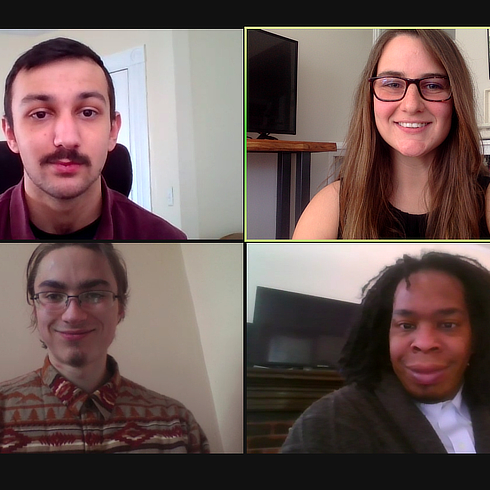
Joseph DiBella, Lamar Lloyd, Nathan Reed, and Angela Terrana
Dr. David Harding
Mr. Kyle Schmidt, Research and Technology Engineer, Albemarle
Albermarle Corporation, global producer of lithium, bromine and catalyst solutions powering the potential of companies in the world’s largest and most critical industries of energy, electronics, and transportation.
To design and analyze a process for the production of diphenyl ethane (DPE) to produce 5000 metric tons of DPE per year, considering operating cost, capital cost, and process safety and producing deliverables regarding mass and energy balances, safety, and flow diagrams. This project seeks to determine the most cost effective and efficient process for a diphenyl ethane production process, maximizing the recycling of raw materials and optimizing for safety. The separation process and unit operations for the most streamlined process will be determined using system models and process knowledge.
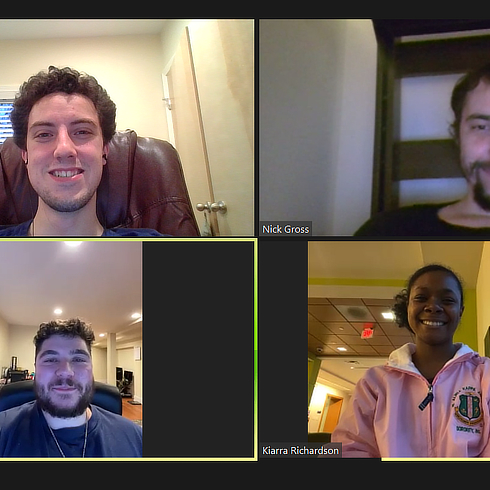
Stefan Derossi, Matt McLaughlin, and Kiarra Richardson (Chemical Engineering), Trenton Perrington (Computer Engineering), Nicholas Gross and Louis Russo (Mechanical Engineering)
Dr. David Harding
Dr. Chong Qiu, Associate Professor of Chemistry
National Science Foundation
To design a humidifier system that can adjust the relative humidity of an enclosure used for research studies relating to aerosols. This system should allow the researcher to manually select the desired relative humidity and automatically adjust the system relative humidity until the target value is reached and maintained. The project seeks to make the researchers work easier and faster to complete.

Affiz Din-Gabisi, George Pappas, and Dominick Passante
Dr. Jean Nocito-Gobel
Mr. Abdul Quadir, City Engineer, Department of Public Works, City of West Haven
The Department of Public Works provides a safe and secure environment for residents, to regulate and administer a wide variety of cost-conscious, crisis responsive, 24/7 public services, and to protect West Haven’s interests in hiring outside contractors from initial bids to project completion.
To conduct a detailed study on the flooding conditions for the Cove River, located in West Haven, Connecticut. This study will produce three deliverables; an updated GIS map demarcating the watershed boundary for the river and impervious areas within it, hydrographs for points of interest along the river, and a map to display the 25, 50, and 100 year flooding conditions for this drainage basin. The proposed study is essential for the Department of Public Works, as much of their current data have not been updated since 1977. The Cover River flood study will help City of West Haven identify obstructions throughout the river, and in turn, manage these blockage points to mitigate flooding events that occur in the future.
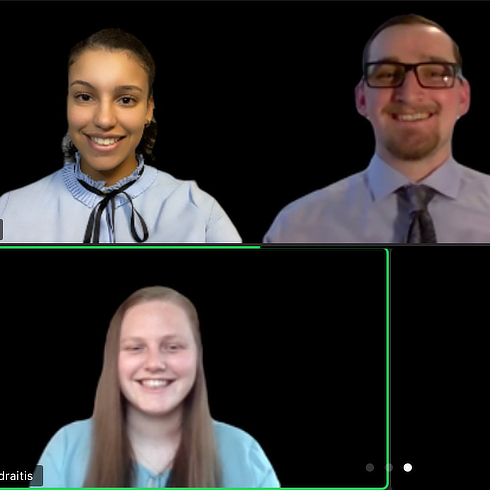
Adra Chbihi, Kevin Clyne, and Rebecca Giedraitis
Mr. Joseph Balskus, P.E.
Mr. Joseph Balskus, P.E., Director of Transportation Systems, Vanasse Hangen Brustlin, Inc.
Vanasse Hangen Brustlin, Inc. (VHB) is a multidisciplinary American civil engineering consulting and design firm for more than 40 years with passionate professionals including engineers, scientists, planners, and designers.
To design an effective and efficient solution to the high traffic intersection of West Broad Street, Liberty Street, and Mechanic Street located in Pawcatuck, Connecticut. The design must achieve a projected crash reduction of 30% and remain within the space limitations of the train-track overpass. All previously allowable traffic (i.e., foot, truck, bus, and POV) will be accommodated in the intersection design and detour routes.
Nathanael Benoit, Christopher Hansford, and Cole Modestow
Mr. Joseph Balskus, P.E.
Mr. Joseph Balskus, P.E., Director of Transportation Systems, Vanasse Hangen Brustlin, Inc.
Vanasse Hangen Brustlin. Inc. believes in working together to deliver resilient and sustainable solutions for clients and the community. Their core values include integrity, balance, quality, diversity, collaboration, super financial performance, stewardship and learning, and development.
To design a roundabout that will improve traffic flow and safety in Campbell Ave. Traffic safety reports have shown that roundabouts reduce crashes by 38%, injuries by 76%, and fatal injuries by 90%. The proposed design is to achieve the goal of improving traffic flow and safety with the implementation of a roundabout. The roundabout will help traffic flow better when at high volumes (peak hour), while also keeping drivers and pedestrians safe with low vehicle speeds.
Sajad Abdul Hakim, Thomas DeAveiro, Douglas McLenithan, and Kenig Ramones
Dr. Abe Ardeshir
Mr. Phil Katz, P.E. and Mr. Joelvito Villaluz Jr., P.E.
City of Norwalk Public Schools
To design structural aspects of a gable truss roof for a new gymnasium and a new bus drop-off, and the onsite drainage system. The new gable truss rooftop will provide cover to the new gymnasium and create a sense of elegance and space from inside. The bus drop-off will have a capacity that holds up to five buses and have a turning radius that will accommodate large vehicles, such as fire trucks. The final aspect of the project will update the current site drainage and sediment control system to accommodate the new gymnasium and bus drop-off in accordance with the City of Norwalk’s 2017 Drainage manual.
Joseph Chrobak, Matthew deCourcey, Alejandra Grisales Arboleda, and Cameron Niemiec
Dr. Goli Nossoni
Mr. Michael Oliver, P.E., Engineering Director, STV Inc. and Mr. Evan Duarte, E.I.T., Engineer, STV Inc.
STV Incorporated, a leader in providing architectural, engineering, planning, environmental, and construction management services for transportation systems, infrastructure, buildings, energy, and other facilities.
To design a replacement structure over the Indian River for US Route 1 in Orange, Connecticut. The project includes performing a structure type study of three structures and determining the most suitable structure for the location. The superstructure as well as the substructure will be designed in accordance with bridge design specification and state guidelines. Both hand calculations and computer analysis will be performed for design of the bridge components.
Matthew Chin , Annie Dengler, and Sarah Sloan
Dr. Emese Hadnagy
Ms. Susmitha Attota, A.I.C.P., Town Planner; Mr. John Casey, P.E., M.B.A., Town Engineer; and Ms. Kelly Kerrigan, Town Environmental Conservation Superintendent
Town of Stratford, which aims to enhance the quality of life within the community by providing services with professionalism and a commitment to excellence.
To design a stormwater drainage system for two parking lots so as to reduce Directly Connected Impervious Areas (DCIA), per the towns Municipal Separate Storm Sewer System (MS4) requirements. The parking lots where the systems are to be designed are located at Frank Scott Bunnell High School and the Baldwin Center, both located in the Town of Stratford. The proposed project seeks to disconnect stormwater runoff from the town’s sewage system, as well as provide treatment to the site’s stormwater runoff. The design must meet the requirements laid out in the Connecticut Water Quality Manual, as well as the Connecticut Drainage Manual.

Yomen Arnaout , Khalim Cisse, and Abdulsalam Osumah (Cybersecurity & Networks)
Dr. Amir Esmailpour
Mr. Saeed Khosravi, Kapalya Technologies
Yale New Haven Hospital, provider of consistently outstanding care, compassionate, patient-centered service and innovative practices to members and Yale University.
To design and build a network that is overall more efficient than the predecessor. The network aims to provide more security, and better performance. The network will also have a high uptime percentage along with the ability to support remote employees. The design will have a guest network and a secure network that is only available to the hospital staff. The network will work smoothly and enable the hospital and its staff to do their jobs better.
Allen Garlock, Joshua Goodart*, Ryan King, and Sophia Mateo (Cybersecurity & Networks)
Dr. Amir Esmailpour
Mr. Saeed Khosravi, Kapalya Technologies
To design an enterprise network that would be capable of supporting the needs of a hospital. The most important part of the network is the Quality of Service, because patient records should be readily accessible online at any given time. Another important aspect of the network is the ability for patients to schedule appointments. The project also seeks to provide a secure location for patient records.
*Joshua Goodart participated as part of this team in fall 2020, but unfortunately passed away in January 2021 due to complications from Covid-19.
Jennifer Alcantara, Dylan Chariott, and Domenick de Nicolo (Computer Science); Sai Teja Reddy Mekala (Cybersecurity & Networks)
Dr. Adwoa Donyina and Dr. Mehdi Mekni
Dr. Armindo Rodriquez and Mr. Eric Gold
Webster Bank helps individuals, families and businesses achieve their financial goals.
To automate the management and configuration of two servers; one for Windows 2019 and one for Red Hat 7+ to guidelines provided by the Center for Internet Security (CIS). In these templates, automated scripts must be implemented using whichever technologies are approved by the client. A process must also be established by which any required exceptions to these baselines can be requested, reviewed and approved or denied.
Andrew Mahr, Connor Blanchfield-Tomaszewski, Jordan Zimmitti, and Samuel Zurowski (Cybersecurity & Networks)
Dr. Vahid Behzadan
The Secure and Assured Intelligent Learning (SAIL) lab, working toward laying concrete foundations for the safety and security of intelligent machines with both theoretical and engineering perspectives.
To use Reinforcement Learning to allow an intelligent agent to be able to conduct proper penetration tests without a human operator. This will allow organizations to save both time and money and avoid potential mistakes by human penetration testers, such as accidentally attacking parts of the infrastructure that could be considered out of scope. A goal of the project is to be able to discover critical defense weaknesses that could soon result in a severe breach that a human penetration tester could miss.
Andrew DeMarco, Ehiremen Ekore, Christopher Dowd, and Alex Socha (Cybersecurity & Networks)
Dr. Adwoa Donyina and Dr. Mehdi Mekni
Mr. Mike Uhl
Neighborhood Housing Services of New Haven (NHS)
To adapt existing open-source code and data to monitor, validate and control a residential building based on common home improvements. The three improvements can be categorized into; 1) capital projects that change the physical building systems, 2) service selections that change providers of retail energy supply and/or onsite generation, and 3) product or occupant changes that modify the timing of equipment operation. The adaptations shall optimize for lowest cost and/or lowest carbon energy use at any time interval of the day and the system shall be operable on a Raspberry Pi 2, 3, or higher device and may also use Amazon Web Services (AWS).
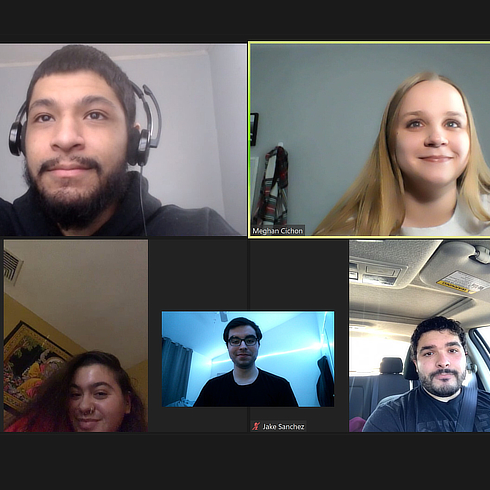
Robert Boutillier, Meghan Cichon, Marcus Novoa, and Jacob Sanchez (Computer Science); and Erica Maggiore (Computer Engineering)
Dr. Adwoa Donyina and Dr. Mehdi Mekni
Ms. Monique Bolt
University of New Haven
To redesign a robot to assist the Undergraduate Admission Office, specifically with campus tours. The robot will be used to interact with prospective families by answering questions and providing facts about the university. The robot should be able to use facial recognition to identify Charger Ambassadors and Admissions Counselors. The navigation mechanism of the robot will also be improved upon allowing users to control the robot in a more intuitive way.
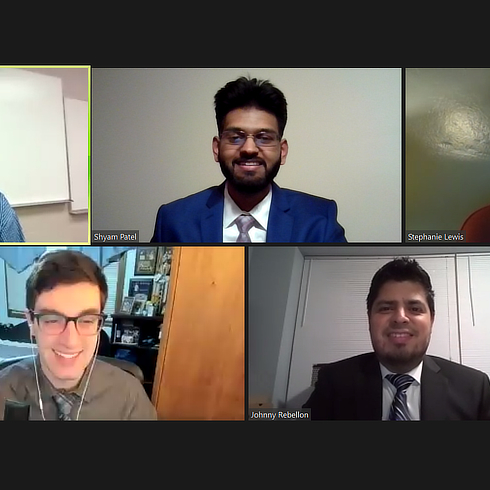
Robert Chenkus, Stephanie Lewis, Johnny Rebellon, and Keegan Schmitt (Electrical Engineering); and Shyam Patel (Computer Engineering)
Dr. Mohsen Sarraf
Dr. Charles Jewart, Engineer Specialist, D442 - SONAR Dev. & Modernization, General Dynamics Electric Boat
General Dynamics Electric Boat, designer and builder of submarines for the U.S. Navy emphasizing consistent development and integration of complex systems.
To demonstrate proof of concept of an alternate method to a traditional RF guidance system. The project involves the development of an ultrasonic guidance system for controlling the movement of a drone. The system would be designed to transmit an ultrasonic signal beam which the drone would lock onto. The transmitted signal beam would be received by an array of ultrasonic sensors mounted on the drone. The drone would then process the signal and move by comparing the various receiver inputs.

Robert Chenkus, Stephanie Lewis, Johnny Rebellon, and Keegan Schmitt (Electrical Engineering); and Shyam Patel (Computer Engineering)
Dr. Mohsen Sarraf
Dr. Charles Jewart, Engineer Specialist, D442 - SONAR Dev. & Modernization, General Dynamics Electric Boat
General Dynamics Electric Boat, designer and builder of submarines for the U.S. Navy emphasizing consistent development and integration of complex systems.
To demonstrate proof of concept that data can be accurately transmitted and received via ultrasound for potential applications undersea. The project involves the development of an acoustic modem that transmits data using ultrasound and a receiver which can read the ultrasonic signal. The modem must modulate and transmit the signal containing data input by a user. Then the receiver must demodulate and process the signal into its original form.
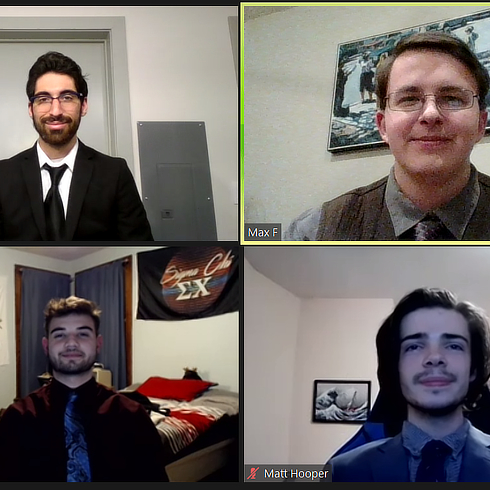
Maximilian Fleischmann, and Mason Kresge (Mechanical Engineering); Thomas Cozzarelli, and Matthew Hooper (Electrical Engineering)
Dr. Ismail Orabi
Mr. William Harding, Distinguished Technical Fellow, and Mr. Roy Wilsker, Senior Director, IT / Technical Fellow
Medtronic (Covidien Division), developer of medical innovations to provide impactful surgical solutions and advance patients’ monitoring and recovery.
To evaluate the current state of machine learning by testing various embedded devices and demonstrate machine learning applications on these devices without relying on cloud-based computing.
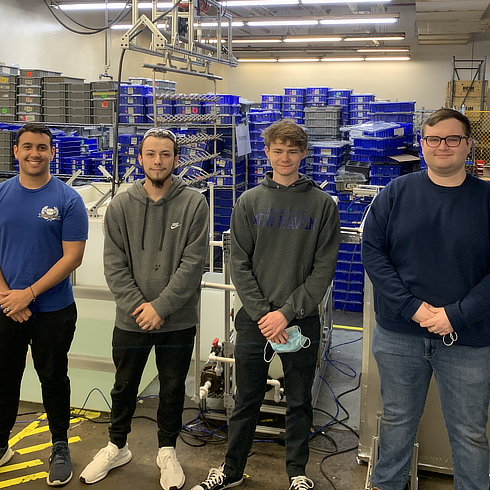
Alex Kosciuszek, John Ryan, and Matthew Garcia (Mechanical Engineering); and Michael Perez (Electrical Engineering)
Dr. Ismail Orabi
Mr. Jack O’Rourke, Manufacturing Engineer, RBC Heim Bearings Company
RBC Heim, provider of global industrial, aerospace, and defense customers with unique design solutions to complex problems and an unparalleled level of service, quality, and support.
To design a system that can apply a “non-stick” coating to 80,000+ parts per year, reduce human labor times by half and fit within the existing footprint allotted. Parts will be degreased, washed, dried, dipped into the “non-stick” coating and baked. This will be done using racked parts and other standard industry practices to increase production in an efficient and high-capacity manner. This project was inherited from the previous senior design team that designed a new manual process for RBC. The intent is to complete the assembly of the system and then automate the process using PLC. This will help reduce the concentration of manual labor and time to complete the cycles, while increasing efficiency.

April Bowen, Jeff DeRosa, Joshua Emerich, and Seth Golembeski
Dr. Ismail Orabi
Mr. William A. Welsh, Sr. Technical Fellow, Dynamics
Lockheed Martin-Sikorsky Aircraft Corporation, designer and builder of the world’s most advanced helicopters for commercial, industrial, and military uses.
To design and build a rotor test rig to simulate a scaled down model helicopter. The test rig will be comprised of a stand and a cam that is capable of rotating blades up to 3600 rpm. The aim is to test various models to get a better understanding of how dynamic components can be altered/refined for the future generation of helicopters and explore a potential system that will be able to measure the force acting on actuating rotor airfoils. This rotor test rig will allow Sikorsky to develop new technologies without needing to produce a full-scale model for each design modification.
Justin Dansereau, Charles Doback, Xavier Parks, and Anyssa Poirier
Dr. Ismail Orabi
Mr. Kasra Fatemi, Tooling Engineer, Edgewell Personal Care
Edgewell Personal Care, a trailblazing personal care company that leverages its employees’ creativity and passion to challenge convention and drive growth.
To design a system that utilizes waste heat from the Milford, CT plastic injection molding facility and converts it into useable thermal or mechanical energy. This project is a result of Edgewell Personal Care’s initiative to increase the energy efficiency of their facilities. If the implemented design increases the efficiency of the Milford facility, the goal is to apply the design to Edgewell Personal Care’s other plastic injection molding locations. The approach to this will be to design two systems, a thermoelectric generation module and an organic Rankine cycle device. For the purposes of this project the thermoelectric generation module will be physically prototyped and tested while the organic Rankine cycle device will stay completely theoretical.
Daniel Buda, Colby Cutler, Chris Dinnis, and Connor Maher
Dr. Ismail Orabi
Mr. Joseph Miranda, Space Systems Mechanical Design Engineer, Collins Aerospace
Collins Aerospace, a leader in technologically advanced and intelligent solutions for the global aerospace and defense industry.
To design and additively manufacture a monolithic pump housing and filter to reduce the operation of replacing parts. This project seeks to filter contaminants and provide steady fluid flow of the coolant while also maintaining an optimal pressure drop of the whole system. The housing must be structurally stable as well as fit the constraints of the available space. Once manufactured, the design will be tested to determine the filter’s performance and structural capability. Data from both initial calculations and physical experiments will be compared to that generated by numerical models.

Bahaa Hoda, Alicia MacDonald, Samuel Rosas, and Shawn Sandor
Dr. Joseph Levert, P.E.
Mr. Jonathan Mixcus, P.E., Thule Group
Thule Group, a global market leader in several product categories such as bike racks for vehicles. Their focus has been on developing smart, stylish products that are environmentally sound and easy to use.
To design, build, and test a new dampening system that: (1) reduces the amount of shock loading and vibration transmitted to carried items, and (2) reduces the wear and tear on the rack and equipment being carried. The project seeks to integrate a vibrational damper system onto an existing hitch mounted bicycle rack that shows a reduction in peak acceleration during Thule’s Slalom Driving and Sleeping Policeman testing standards.
Alex Lowe, and Amber Wallgren (Mechanical Engineering); Francisco Estevez and Michael Tomarelli (Electrical Engineering)
Dr. Mohsen Sarraf
Mr. Sam Matus, Product Manager, and Mr. Francis Pellicano, Electrical Engineer, Ultrasonics Division, Strain Measurement Devices
Strain Measurement Devices, an industry leader in custom sensor technology that provides clients with quality solutions to their sensing needs.
To design and build a non-invasive continuous ultrasonic liquid level sensor that will measure the height of a liquid from the outside of a vessel. The design should allow for relatively easy vessel replacement, automatic calibration to a range of ambient temperatures and liquid types and reliable measurements with 1 mm resolution.
Leonardo Feliciano , Bernard Grant, and Zahraa Sahi (Electrical Engineering); Eric Meeson, and Skyler Szerszen (Mechanical Engineering)
Dr. Joseph Levert, P.E.
Dr. Chong Qiu, Associate Professor of Chemistry
National Science Foundation
To integrate an Aerosol Particle Mass (APM) Analyzer module into a much larger aerosol research apparatus. The integration involves valves and controls to connect to the research apparatus, a safety relief valve to prevent damage to the APM module, and a protective housing. Integrating the APM module will enable research on aerosol particle mass distribution measurement, particle density, and monodisperse aerosol generation. This will enable cutting edge research for undergraduate and graduate research students at the university.

Erica Maggiore, and Trenton Perrington (Computer Engineering); Mikayla Bowerfind, Matthew Kozek, and Jose Pareja (Mechanical Engineering)
Dr. Joseph Levert, P.E.
Dr. Soweto Thomas, Associate Scientist & New Product Development-Characterization Team WB Lead
Abcam Corporation, developer and provider of high-quality biological reagents and tools which are essential in a wide range of fields and applications including drug discovery, diagnostics and basic research.
To design and build an automated apparatus/system that will undertake the task of filling and draining wells containing primary antibodies with blocking reagents during a standard “Western Blot” process. This project seeks to optimize the process by decreasing the amount of time spent manually filling and draining the wells, as well as minimizing the chance of human error with the flip of a switch. The processes should be fully automated and work under standard Abcam operating conditions and tolerance.
Jessica Bologna (Mechanical Engineering); Patrick Dooley (Electrical and Mechanical Engineering); and Joseph Quinn (Electrical Engineering)
Dr. Mohsen Sarraf
Mr. Milton Ives, COO, Advanced Composites & Metal forming Technology
ACMT, manufacturer of aerospace components with streamlined processes to the highest industry standard.
To use structured light for the inspection of metal fabricated parts, specifically various 343 brackets, and to compare them to predefined CAD drawings, in addition to automating this process as much as possible. Currently, this process is time consuming and not ideal for repeatability between parts. Integrating the use of a FaroArm to project the structured light will ensure a complete scan of the part and accurate readings despite reflective part finishes. The approach being taken is to focus on writing a generalized program for the FaroArm to run autonomously and still maintain accurate and complete scans of the parts.
Trey Gary (Computer Engineering); Jake Fucci (Electrical Engineering); Jordan Cubero and Kevin Antoine (Mechanical Engineering)
Dr. Mohsen Sarraf
Mr. John Leonard, Chief Engineer, Nordco Inc.
Nordco Inc., provider and maintainer of highly engineered, specialized, and innovative equipment and services through their product life cycle to maintenance-of-way, mobile rail freight handling, and other rail-related markets.
To design and build a six-wheel system that automatically refills or deflates pressure to help check for cracks in the railroad through the usage of an ultrasonic sensor. Maintain a low cost and stay within budget.
We thank our industry sponsors who served as customers for our students as well as supporting their prototyping expenses. As customers, they gave valuable time and insights that uniquely benefited our students with an experiential design education in a real-world setting, which greatly complements the team mentoring by our faculty colleagues. Their generous commitment to our students brought their design education to life.