Why Medical Laboratory Science?
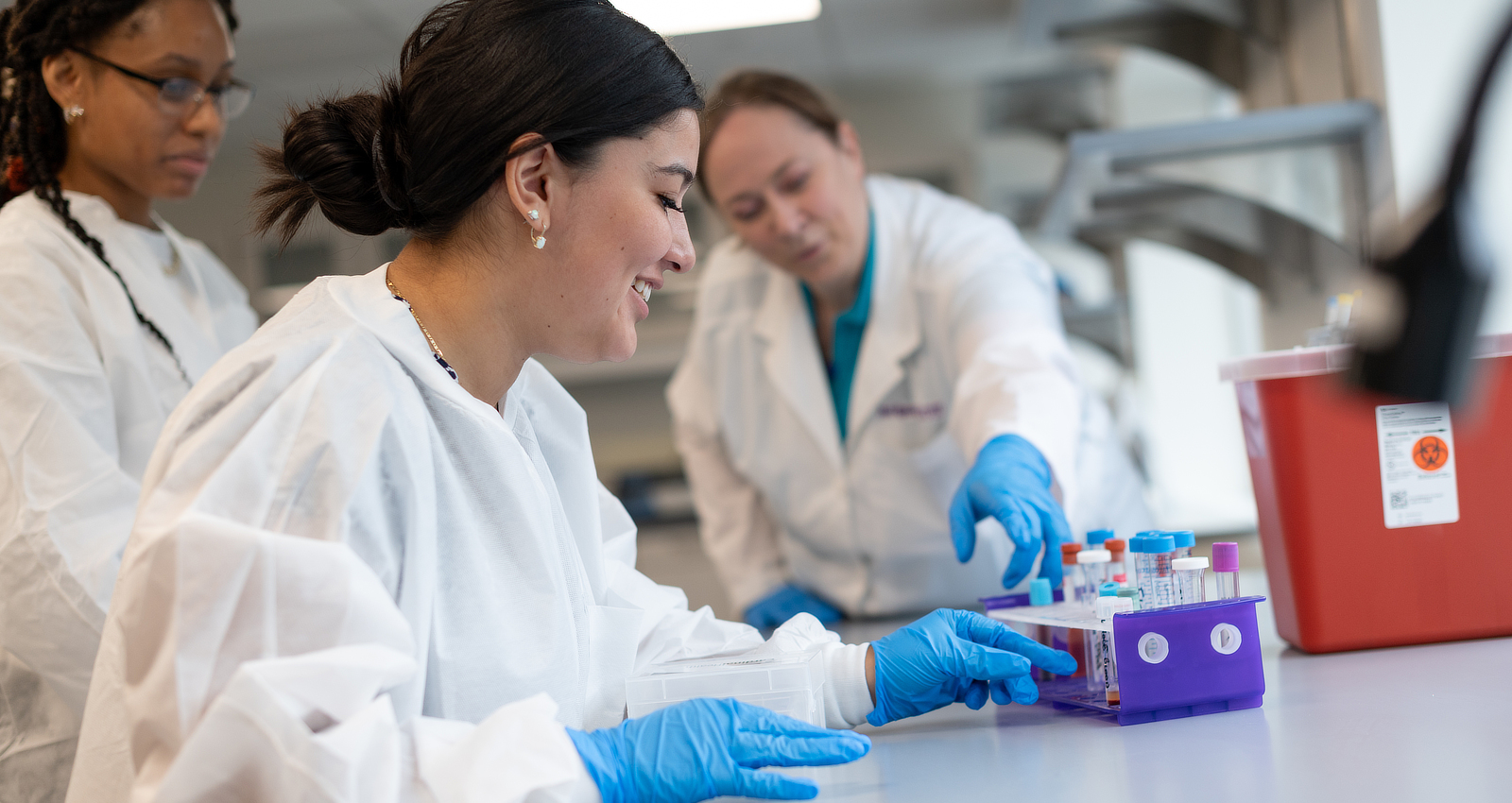
Laboratory analysis by medical laboratory scientists plays a critical role, along with that of the physician, in disease diagnosis, treatment, and health maintenance. Medical laboratory scientists are professionals who are prepared not only to produce laboratory data but also to assure the quality of the data, compare and select laboratory methods, advise other healthcare professionals on the data’s validity, and supervise laboratory personnel.
Why MLS at the University of New Haven?
Our program of study is designed to provide the knowledge and technical skills necessary to qualify an individual for work in a diagnostic clinical laboratory, in research, or in industry. Students complete two years of pre-professional courses in science and general education and two years of professional medical laboratory science (MLS) coursework. The professional coursework includes didactic courses, student laboratory instruction, and clinical experience rotations.
Our program focuses on preparing you successfully for the workplace and your American Society for Clinical Pathology (ASCP) certification exam. It is a priority of the MLS program to ensure quality clinical rotation experiences for students so they are prepared to begin clinical practice.
Mission
The mission of the Medical Laboratory Science program is to provide a rigorous, competitive undergraduate training program to prepare graduates to become competent medical laboratory scientists who demonstrate ethical standards and promote patient-centered care.
Vision
The vision of the Medical Laboratory Science program is to become a destination program for medical laboratory science in the region recognized for quality faculty, strong industry partnerships, and successful graduates. All graduates from the MLS program will become competent, ethical, certified MLS professionals prepared to become an essential member of the healthcare team.
Objectives
Professional Communication: To interact and communicate effectively by presenting information in oral and written formats, collaborating with professionals, peers, and clients, expressing ideas clearly, and giving and receiving feedback to serve the needs of patients, the public and members of the health care team.
Professional Competence: To possess knowledge, skills, and abilities to acquire an entry level position as a Medical Laboratory Scientist and to successfully complete the ASCP BOC MLS examination.
Professional Ethics and Conduct: To learn to treat patients and colleagues with respect, care, and thoughtfulness, to perform duties in an accurate, precise, timely and responsible manner, to maintain strict confidentiality of patient information and test results and to exercise professional judgment, skill and care while meeting established standards of the MLS profession.
Professional and Personal Development: To continuously improve and apply medical laboratory skills and knowledge and share such with colleagues, other members of the health care community and the public.
The Directors and Admissions Counselors in the Office of Undergraduate Admissions, in consultation with the MLS Program Director, select MLS students utilizing the MLS Program Admission Criteria and Procedures.
Compiled by Carleta B Maurice MS, MT (ASCP) Director, MLS Program, PIR, in accordance with the University of New Haven Office of Undergraduate Admissions.
Full-Time First-Year Students
- Complete and submit an online Undergraduate Application for Admission.
- Submit official secondary/high school transcript including:
- Science grades: must have a “B” grade or better in biology and chemistry
- Math grades: must have a “B” grade or better in all math courses
- GPA: 2.9 / higher on a 4.0 scale
- OPTIONAL: Official SAT or ACT Scores
- Submission of SAT or ACT test scores for admission is optional for incoming undergraduate and transfer student applications.
- Submit at least one (1) letter of recommendation.
- An interview with the MLS Program Director is optional.
Full-Time First-Year Transfer Students
(Those who have completed fewer than 12 credits from their previous college(s))
- Complete and submit an online Undergraduate Transfer Application for Admission.
- Submit official secondary/high school transcript including:
- Science grades: must have a “B” grade or better in biology and chemistry
- Math grades: must have a “B” grade or better in all math courses
- GPA: 2.9 / higher on a 4.0 scale
- OPTIONAL: Official SAT or ACT Scores
- Submit at least one (1) letter of recommendation.
- Submit official transcripts from all colleges/universities you attended:
- Transfer credits to be accepted with a “C-” grade or better and/or with the department chair’s approval.
- All transfer math and science courses require a “C” grade or better.
- College GPA: 2.7 / higher on a 4.0 scale; or demonstrates evidence of recent successful academic college/university performance.
- An interview with the MLS Program Director is optional.
International Students
- Complete and submit an online Undergraduate International Application for Admission.
- For First-Year Applicants (Students who just finished, or in the process of finishing, secondary/high school): Submit OFFICIAL/notarized/attested/or certified copies of ORIGINAL senior secondary/high school records. Must adhere to the admission criteria and procedure for the full-time freshman students listed above.
- For Transfer Applicants: Students who have attended any post-secondary institution (college/university): Submit OFFICIAL/notarized/attested/or certified copies of ORIGINAL senior secondary/high school records (see 2.a. above) AND ALL post-secondary school (university/college) records. Adhere to the admission criteria and procedure for full-time transfer students above.
- All non-native English language speakers must demonstrate English language competency by providing a TOEFL score of 80 on the internet-based test (iBT), IELTS score of 6.5, or official SAT or ACT Scores.
- An interview with the MLS Program Director is optional.
For the three above:
- The Directors and Admissions Counselors in the Office of Undergraduate Admissions, in consultation with the MLS Program Director, select MLS students utilizing the MLS Program Admission Criteria and Procedures.
- After completion of the Sophomore year (see academic worksheet), students will be evaluated by the MLS Academic Standards Committee: A cumulative grade point average of 2.7 / higher on a 4.0 scale is required for continuance in the Junior-level MLSC courses of the MLS program.
- For additional information about the MLS program access newhaven.edu/health-sciences
Full-Time Sophomore Transfer Students
(Those who have completed more than 12 credits from their previous college(s))
- Complete and submit an online Undergraduate Transfer Application for Admission.
- Submit official transcripts from all colleges/universities you have attended:
- Transfer credits to be accepted with a “C-” grade or better and/or with the department chair’s approval
- All math and science courses require a “C” grade or better
- College GPA: 2.7 / higher on a 4.0 scale; or demonstrates evidence of recent successful academic college/university performance.
- An interview with the MLS Program Director is optional.
The National Accrediting Agency for Clinical Laboratory Science (NAACLS) requires that the MLS program publish the following list of essential program functions. These “Technical Standards/Essential Functions” make up the non-academic requirements of the profession that all students must demonstrate to succeed in the UNewHaven MLS program. The essential professional, communication, and technical requirements for Medical Laboratory Sciences students are listed below. If there are changes in these essential requirements, those changes will be published, and students will have the opportunity to discuss any changes with the Program Director and instructors in the Medical Laboratory Sciences Program.
The Technical Standards/Essential Functions required for successful completion of the MLS program at the University of New Haven are listed below. In accordance with the university’s commitment to providing equal access for individuals with disabilities under Section 504 of the Rehabilitation Act of 1973 and the Americans with Disabilities Act Amendments Act (ADAAA of 2008), students seeking reasonable accommodations to meet these requirements should contact the Accessibility Resources Center to ensure appropriate accommodations can be made in a timely manner.
Professional skills
- Maintain professional decorum and composure in a wide variety of situations
- Maintain confidentiality and integrity
- Follow directions, be able to make decisions, prioritize tasks, and work on multiple tasks simultaneously
- Work independently and in cooperation with others
- Apply acquired learned skills and knowledge to new situations
- Work with potential biologic, chemical, radiologic, mechanical, and electrical hazards
- Maintain personal hygiene and neatness appropriate to the professional workplace
- Achieve regular, reliable, and punctual attendance at classes and regarding their clinical responsibilities
Communication skills
- Communicate effectively and efficiently with coworkers and members of the healthcare team
- Read and comprehend written material
- Record information accurately and clearly
Technical skills
- Complete fine repetitive movements such as pipetting
- Manipulate lab instruments
- Demonstrate proficiency to work with flammable and infectious materials, hazardous chemicals, and electrical equipment
- Demonstrate proficiency in all areas of the clinical lab
- Work in areas with distracting noises, unpleasant odors and in close proximity to fellow workers
- Perform all diagnostic procedures in the clinical lab
- Perform delicate manipulations of clinical specimens, clinical lab equipment, tools, and instruments
- Perform diagnostic procedure and venipuncture safely and accurately
- Adhere to standard precautions and meet safety standards applicable to the clinical laboratory
- Accurately identify, describe, and record fine details of clinical specimens both macroscopically and microscopically
- Read and interpret charts, graphs, and labels
- Read and interpret instrument panels and printouts
- Independently perform all aspects of diagnostic procedures in the clinical lab and report results accurately and timely
| Rates | Academic Year 2022-2023* | Academic Year 2023-2024* | Academic Year 2024-2025* | 3-Year Averages |
|---|---|---|---|---|
| CERTIFICATION RATES: For program graduates who took the ASCP BOC exam within one year following graduation | 100% pass rate (ASCP BOC MLS certification) | 67% pass rate (ASCP BOC MLS certification) | 86% (ASCP BOC MLS certification) | 80% pass rate (ASCP BOC MLS certification) |
| ATTRITION/GRADUATION RATES: For students who began the last year of the program | 100% graduation | 100% graduation | 100% graduation | 100% graduation |
| PLACEMENT RATES: Graduates who found employment (in MLS or a closely related field) and/or continued their education within six months of graduation | 100% placement | 100% placement | 86% placement | 93% placement |
*Class size information (number of graduates)
2022-2023: 2; 2 of 2 students attempted and passed MLS certification exam
2023-2024: 6; 6 of 6 attempted exam, 4 of 6 students passed MLS certification exam
2024-2025: 7; 7 of 7 students attempted exam, 6 of 7 students passed MLS certification
exam
These are combined results for all MLS program graduates (both B.S. and M.S. degrees)
Post-Baccalaureate Second Bachelor's Option
Students who already hold a B.S. in the biological, forensic, chemical, or physical sciences have the option to earn a second bachelor’s degree in Medical Laboratory Science in as few as two years, thanks to the fact that they have already met many of the prerequisites for the program. We also offer an entry-level master’s program in Medical Laboratory Science which is designed to grant the student a graduate degree while completing the necessary program-specific coursework.
In both options, students complete — within two semesters — clinical rotations that give them invaluable hands-on experience.
At the conclusion of both programs, students are eligible to take the national certification exam to qualify as a medical laboratory scientist. Most employers require certification to work as a medical laboratory scientist in a clinical laboratory. With a critical nationwide shortage of certified medical laboratory scientists, market demand has resulted in increased salaries and excellent job placement.
B.S. in Medical Laboratory Science Program Quick Facts
Total Credits: 121-123
Designation: STEM-Designated
Accreditation: This program is fully accredited by the National Accrediting Agency for Clinical Laboratory Sciences (NAACLS), awarded in April 2023 for a period of 5 years.
National Accrediting Agency for Clinical Laboratory Sciences
5600 N. River Rd, Suite 720
Rosemont, IL 60018-5119
Phone: (773) 714-8880
Email: info@naacls.org
Career Opportunities with a Bachelor's Degree in Medical Laboratory Science
$76K
Medical Laboratory Scientist / Clinical Laboratory Scientist
9% Growth, 2025-2035
$77K
Point-of-Care Testing Coordinator
$73K
Laboratory Information System (LIS) Personnel
Medical Laboratory Science Courses and Learning Outcomes
Students prepare to work in the medical laboratory science field by developing comprehensive knowledge of the biological, physical, and health sciences as they relate to laboratory medicine.
First, students take a wide range of courses to prepare them to work in the healthcare industry. The School of Health Sciences core curriculum provides students with a broad, interdisciplinary understanding of how prevention, health policy, and person-centered care affect all health professionals.
In their sophomore year, students begin taking biological and physical sciences coursework to prepare for their preclinical MLS classes. As a junior, students complete a full year of preclinical MLS courses that cover the major areas of medical laboratory work.
Over the course of their last two semesters, students complete the remaining preclinical MLS coursework and prepare for entry into their clinical rotations. All students complete a clinical internship at one of our affiliate laboratories, where they practice their skills under the supervision of an experienced medical laboratory scientist.
The information below comes directly from the latest Academic Catalog:
Clinical Laboratory Science Graduate Certificates
Current Clinical Affiliates
All students in the MLS program must complete a series of clinical rotations to graduate. Clinical site placement is determined at the end of the second-to-last semester, and rotations occur during the final semester of the program. For more details on this process, please refer to the student handbook.
We prepare you for all career possibilities
Health Professions Advising Center (HPAC)
HPAC WebsiteSHS Study Abroad Opportunities
Watch Video
Pre-Medical Studies Designation
Pre-Med WebsiteNationally Recognized Center for Career Development
All University of New Haven students have access to the many resources available through the University’s Career Development Center, which has been named one of the best in the nation by The Princeton Review.
From career assessments, networking, and job shadowing to on-campus interviews and salary negotiation, the Career Development Center provides the skills and connections to identify a meaningful career and an opportunity to pursue your passion.
Learn More
Our faculty are leaders and innovators in their fields, bringing both deep professional
experience and academic rigor to the classroom.Learn from professors who are dedicated to your success.
Charger Advantage

Next Steps
Whether you're still in high school or are transferring from another college, we offer full- and part-time opportunities for undergraduates from inside the U.S. and abroad. The admission process can begin as early as the end of your high school junior year.
The Application Process WebsiteWe offer a comprehensive financial aid program, with students receiving assistance in the form of grants, scholarships, student loans, and part-time employment. Funds are available from federal and state governments, private sponsors, and from university resources. More than 95 percent of the University's full-time undergraduate students receive some form of financial assistance.
Financial Aid WebsiteWANT MORE INFO?
Find out more about why the University of New Haven is a great fit for you. Our admissions team will contact you with information personalized to your interests.
VISIT
A campus visit is one of the most important parts of the college selection process. Come feel what it's like to Be a Charger!
APPLY
With more than 74,000 alumni and more than 100 years of history, #ChargerNation is the place to be. Begin Your Journey today.