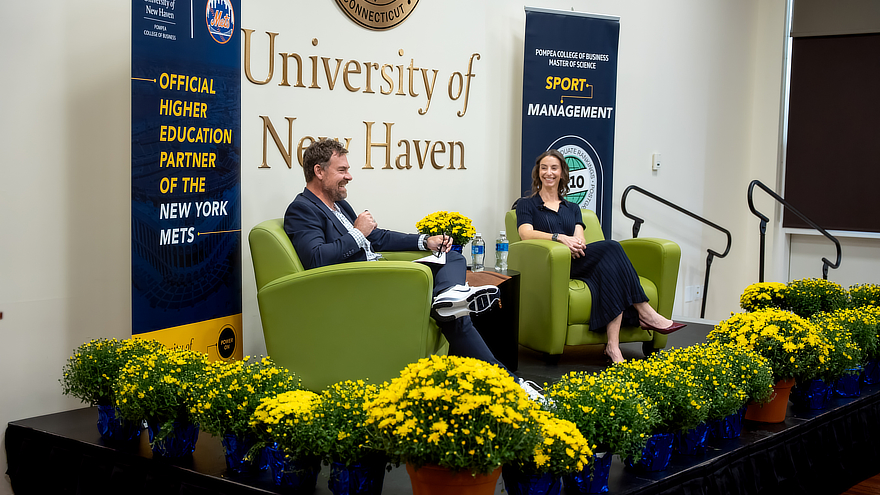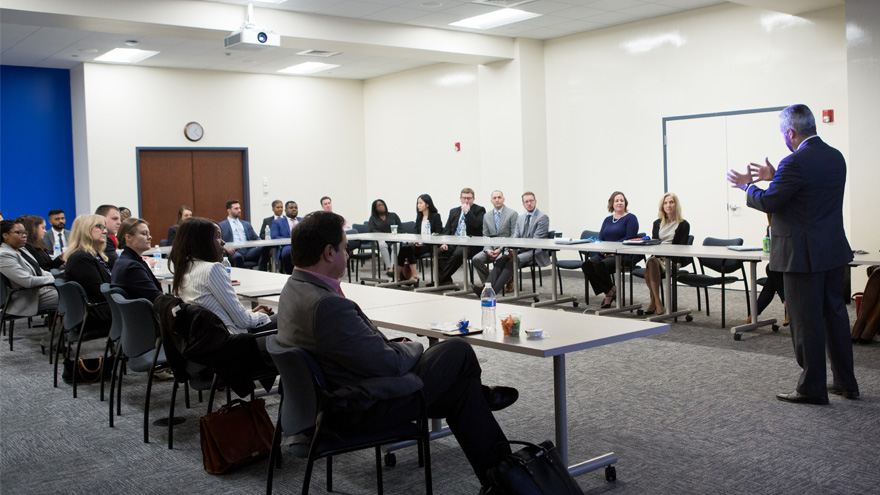
Jestine Philip, Ph.D., Board of Governors Chair Michael Ambrose ’84, ’19 Hon., and David Rosen ’26 combined academic, industry, and student perspectives on digital transformation in complex product development through a research paper presented at the European Academy of Management (EURAM) conference in Norway.
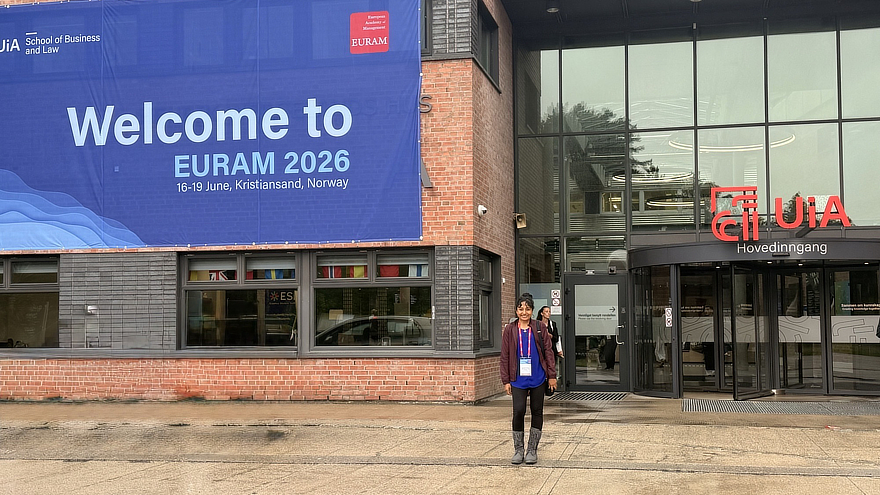
A University of New Haven research project took on a unique collaborative twist as it involved faculty member Jestine Philip, Ph.D., Board of Governors Chair Michael Ambrose ’84, ’19 Hon., and recent graduate David Rosen ’26 bringing together their academic, industry, and student perspectives on digital transformation in complex product development.
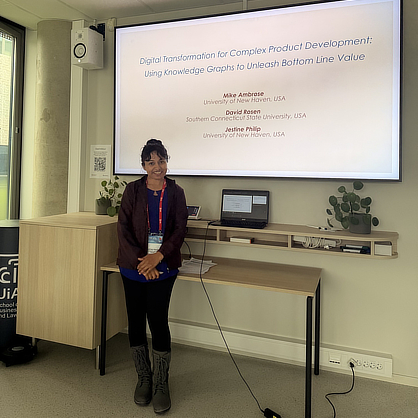
The paper, which explores how organizations can use digital processes and tools to improve the development of highly complex manufactured products, was accepted for presentation at the European Academy of Management (EURAM) conference earlier this year.
Dr. Philip, Chair Ambrose, and Rosen developed the paper over several years, combining Chair Ambrose’s decades of industry experience, Dr. Philip’s management research, and Rosen’s perspective as a research assistant. Dr. Philip presented the paper at the conference.
The collaboration began after Chair Ambrose read about Dr. Philip’s research on digital transformation in the University of New Haven’s Magazine. “Mike very graciously reached out to my dean, and the dean then contacted me,” Dr. Philip said.
Rosen later joined the project after Dr. Philip asked him to review the work. His fresh perspective helped the team shape a highly technical subject for a broader audience. “We thought the three of us would be a better team than just the two of us,” Dr. Philip said. “The three of us brought different perspectives to the paper”
‘A consistent thread of digital transformation’
Chair Ambrose’s interest in digital transformation grew from a career spanning nearly four decades at Sikorsky Aircraft, where he held a variety of positions, including serving as vice president of engineering and chief engineer.
“I’ve always had a consistent thread of digital transformation throughout my various roles,” Chair Ambrose said, tracing that experience back to the introduction of computers and computer-aided design at Sikorsky in 1983.
Chair Ambrose brought an implementation and technology perspective to the project, while Dr. Philip approached the subject through organizational research. The combination, he said, created “a good balance.”
‘The final piece’
Rosen, who earned a degree in business management, joined the project as a research assistant from the Pompea College of Business. He brought a perspective shaped by his limited prior research experience and a focus on readability.
“I was able to use plain language to the point where anyone, or at least people with some surface-level knowledge, could read it and understand it,” Rosen said.
Dr. Philip said Rosen helped the team make the paper accessible beyond its technical and academic roots. “I actually once told David after he read the paper that I felt like he understood the paper better than I did,” she said.
Chair Ambrose similarly described Rosen as “the final piece,” helping to ensure the paper stayed on target for its intended audience.
‘Enhance the paper further’
The paper examines how organizations can use digital processes and tools to reduce costs and improve highly complex products, when numerous variables, interfaces, and data sources can make digital transformation difficult.
The research considers approaches such as value stream mapping and knowledge graphs in complex product development, with a focus on how organizations can more systematically realize value from digital investments.
“The paper is around what the process is, what the organization is, and some tools that would allow you to systematically figure out how to get benefits from these digital investments,” Chair Ambrose said.
At EURAM, the paper was presented within the conference’s new product development track. Dr. Philip said the presentation generated favorable feedback and helped the team further shape the paper for its next stage.
“The feedback they gave us is definitely useful,” Dr. Philip said. “They’re largely the ones who would read academic research papers so we’re going to use their feedback to enhance the paper further.”
‘Continue to aim high’
The EURAM acceptance also represented an important milestone after earlier rounds of rejection and revision. Chair Ambrose called the acceptance “a validation of all the hard work that we put in over two or three years.”
He said the project also represents a small piece of a broader effort to strengthen the University’s reputation. As chair of the University of New Haven’s Board of Governors, he said contributing to work that reflects positively on the University is an important part of his involvement.
“Anything that’s going to help University of New Haven is one of the focus areas for anything we do,” Chair Ambrose said. “In one small way, we’re hoping that this helps.”
The team’s next step is to incorporate the conference feedback and submit the paper to a multidisciplinary research journal, where it could reach both business management and engineering researchers. “That’s the next stage in the paper,” Dr. Philip said.
For Dr. Philip, the experience reinforced her belief that the paper was worth continuing to develop. “There was something in it that told me we should continue to aim high,” she said. “I felt it was worth people reading and hearing it.”
Contact
Get the highlights!
Stay up to date with our weekly e-newsletter, highlighting stories from around the University and media clips featuring our faculty experts.
Recent News
The Charger Blog

University of New Haven Researchers Advance Health Equity and Health-System Transformation
The Charger Blog